


The Hélys 12-17 Program is Designed For
All parents of adolescents aged 12 to 17 who desire to learn more about parenting. This program does not meet the needs of parents experiencing complex difficulties that interfere with family functioning.
The Hélys 12-17 Program Addresses
Hélys 12-17 offers content on the following topics to parents of adolescents:
- Adolescence 101
- Friendship and Love During Adolescence
- Adolescence and the Digital Era
- Interests and Vocational Guidance During Adolescence
Objectives of the Hélys 12-17 Program
Hélys 12-17 promotes the development and well-being of adolescents by supporting parenting practices.
- Increasing the Knowledge of Parents: Give parents essential information on adolescence and effective parenting practices.
- Reinforce the Feeling of Parenting Competency: Help parents feel more confident and competent about their role.
Tier of Intervention
The Hélys 12-17 program offers a universal Tier 1 intervention for parents of children aged 12-17.
Supporting parents of adolescents aged 12 to 17 in their parenting practices
According to Measure 1.3 of the 2022-2025 Interdepartmental Action Plan of the Government Health Prevention Policy (MSSS, 2022, p.17), it is important to “offer support to parenting practices adapted to the needs of the different population groups” and to give parents better access to resources to support them in their role.
Boscoville Listens to the Parents: Understanding and Meeting the Support Needs of Families
During discussion groups organized in the context of the program’s experimentation phase, parents of adolescents (aged 12 to 17) having no specific problems and living on the island of Montréal have voiced their:
- Concerns regarding the development of their adolescents
- Concerns regarding the quality of their relationship with their youths
- Need for obtain reliable information
- Need for concrete tools and strategies to implement daily
- Need of a service offering that considers their family reality, with a wide range of conditions
What You Get with Hélys 12-17
Implementation Essentials for Hélys 12-17
-
Management Commitment
The manager in charge takes the leadership role for the program by ensuring favourable conditions for the implementation. They must provide the necessary human resources, support the program promotion and participate in the various planning and assessment meetings.
-
Adequate Human Resources
The facilitation of the workshops and presentations with the parents must be carried out by two facilitators, including one who has undergraduate training in psychosocial intervention or significant intervention experience. The environment must also designate a resource person responsible for planning and coordinating the program’s implementation (this person can be one of the facilitators).
-
Implementation of All the Program’s Components
It is essential to offer all the components, including the presentations, podcasts and infographic sheets, which together make up the whole program.
Take the Next Steps
Would you like more information about the Hélys 12-17 program?
The Hélys 12-17 Program Across Québec
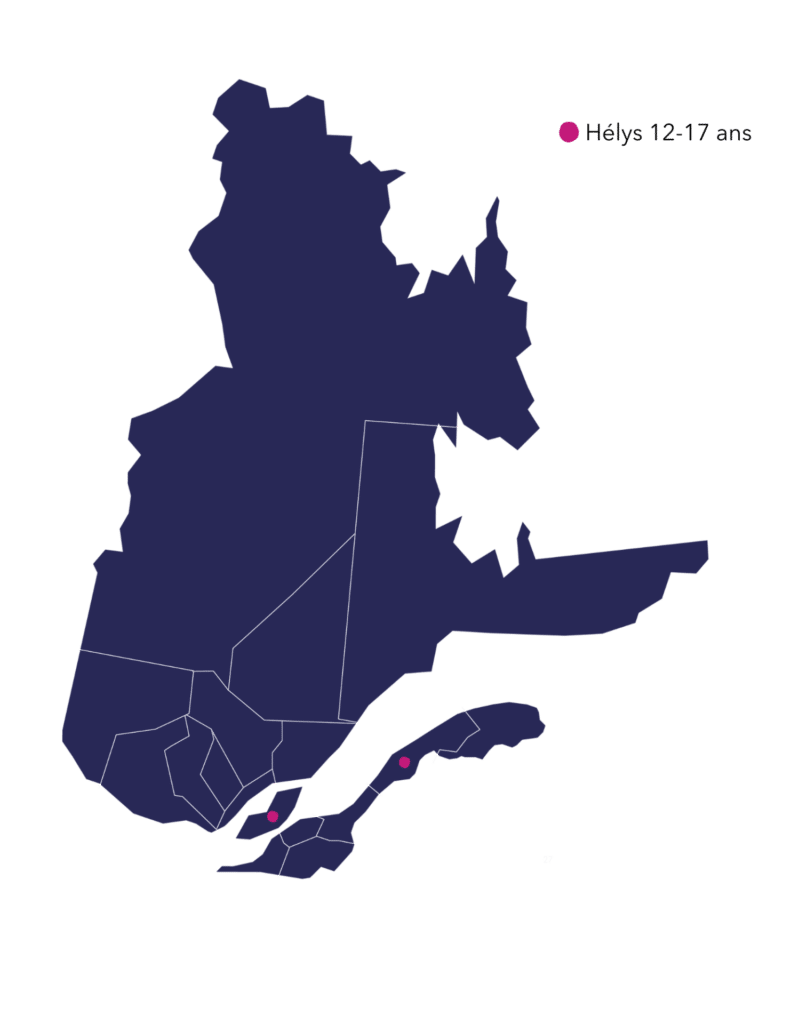
16 TRAINED SOCIAL CARE PROFESSIONALS
4 ENVIRONMENTS IN THE EXPERIMENTATION PHASE

Get the Latest About Hélys 12-17!
Exclusive Resources for Hélys 12-17
A wide range of exclusive tools to support the parents of adolescents aged between 12 and 17.

Additional Information
Report from the Director of Public Health The Health and Development of Children in Montréal
Dr. Mylène Drouin, Director of the Regional Public Health Directorate of Montréal, published a report on the health and development of children in Montréal, offering a description of children aged 0 to 12 through their experiences and living environments.
In response, Boscoville is proud of Hélys, its new universal program supporting parenting practices, designed to reinforce the competencies of parents and promote positive practices for the well-being and development of children. See Chapter 7, page 22
Find Out More
Associate Fellow in Charge of the Program Evaluation

Marie-Ève Clément, Ph. D.
Full Professor, Department of Psychoeducation and Psychology, Université du Québec en Outaouais (UQO).
Committees
Scientific Committee

Marie-Hélène Véronneau
Full Professor, Department of Psychology, Université du Québec à Montréal (UQAM).
Catherine Cimon-Paquet, M.Sc.
PhD candidate, Department of Psychology, Université du Québec à Montréal (UQAM).

Sarah Dufour, Ph. D.
Full Professor, School of Psychoeducation, Université de Montréal.
Marie-Ève Clément, Ph. D.
Full Professor, Department of Psychoeducation and Psychology, Université du Québec en Outaouais (UQO).
Steering Committee

Laurence Boucheron
cheffe de service Périnatalité, enfance, familles et communautés, DRSP
Sarah Dufour, Ph. D.
Full Professor, School of Psychoeducation, Université de Montréal.
Marie-Ève Clément, Ph. D.
Full Professor, Department of Psychoeducation and Psychology, Université du Québec en Outaouais (UQO).
Catherine Dea
responsable médicale du service Développement des enfants
Ginette Vézina
directrice du développement et des liaisons Réseau Réussite Montréal
Advisory Committee
Researchers and Consultants
Laurence Boucheron
cheffe de service Périnatalité, enfance, familles et communautés, DRSP
Sarah Dufour, Ph. D.
Full Professor, School of Psychoeducation, Université de Montréal.
Marie-Ève Clément, Ph. D.
Full Professor, Department of Psychoeducation and Psychology, Université du Québec en Outaouais (UQO).
Mylaine Cardin
conseillère pédagogique
Janna Gillis
conseillère liaison au sein de l’équipe FSSTT
Maeve Hautecoeur
agente de planification, programmation et recherche – Familles et communautés, DRSP

Mélanie Jodoin
Étudiante à la maîtrise, École de psychoéducation | Université de Montréal
Elizabeth Roberts
psychologue et coordonnatrice du programme REACH
Milène Roger-Tessier
agente de liaison et de développement
Stephanie Stever
directrice, Services aux élèves
Andréane Tardif
agente de planification, programmation et de recherche
Ginette Vézina
directrice du développement et des liaisons Réseau Réussite Montréal
Christian Urbain
directeur du Réseau des écoles de Montréal-Est, de Pointe-aux-Trembles et des écoles spécialisées
Natalie Zirnhelt
directrice adjointe – Direction des programmes jeunesse et des activités de santé publique
Expert Collaborator for the Development and Recording of the Podcast Episodes

Mélissa Bégin
conseillère d’orientation

Benoit Hammarrenger
neuropsychologue

Fre Lépine
sexologue

Emmanuelle Parent, Ph. D.
communication – Fondation Le Ciel
External Consultants
Mireille Moisan
Guidance counsellor, inspector and project manager for the Quebec Order of Guidance Counsellors (Ordre des conseillers et conseillères d’orientation du Québec).
Maya Alieh
Detective Sergeant with the SPVM, Supervisor of the Specialized Cybercrime Investigations Unit.

Véronique Gauthier, Ph. D. c,
Tenured Professor in Social Work, Department of Psychology and Social Work, Université du Québec à Rimouski (UQAR).
Raymond Villeneuve
Directeur Général : Regroupement pour la Valorisation de la Paternité
This Program is Developed in Partnership with


In Partnership With