



Based On
- The trauma-informed approach
- Blaustein and Kinniburgh’s Attachment, Regulation, Competency (ARC) model (2010; 2018)
- Sugai and Horner’s Positive Behavioral Interventions and Supports (PBIS) (2002 and 2009)

The Foundations of the Pingouin-Polaris Program
The foundations of the Pingouin-Polaris program combine the principles of the ARC model (Blaustein & Kinninburg, 2018) and the PBIS intervention framework (Sugai & Horner, 2002 and 2009). These models focus on the prevention of difficult behaviours and complement each other.
ARC offers ways to organize an environment and equip care workers with practices that are adapted and sensitive to the complex trauma experienced by clients.
The PBIS framework proposes a method for organizing environments in a predictable and coherent way. It integrates various proactive and educational strategies to prevent disruptive behaviour while promoting the development of young people’s social-emotional skills.
Objectives of the Pingouin-Polaris Program
The goal of the program is to support educational teams that work with young people that have adjustment difficulties.
Specifically, the program aims to increase the application of trauma-informed practices among educators.
On the other hand, it aims to reduce the use of certain more punitive practices, such as restraint, seclusion and time-out.
The proposed program also aims to promote the development of resilience in youth by offering them ways to interact positively with a safe environment that focuses on the development of regulation and certain key skills.
Complex Trauma in Youth
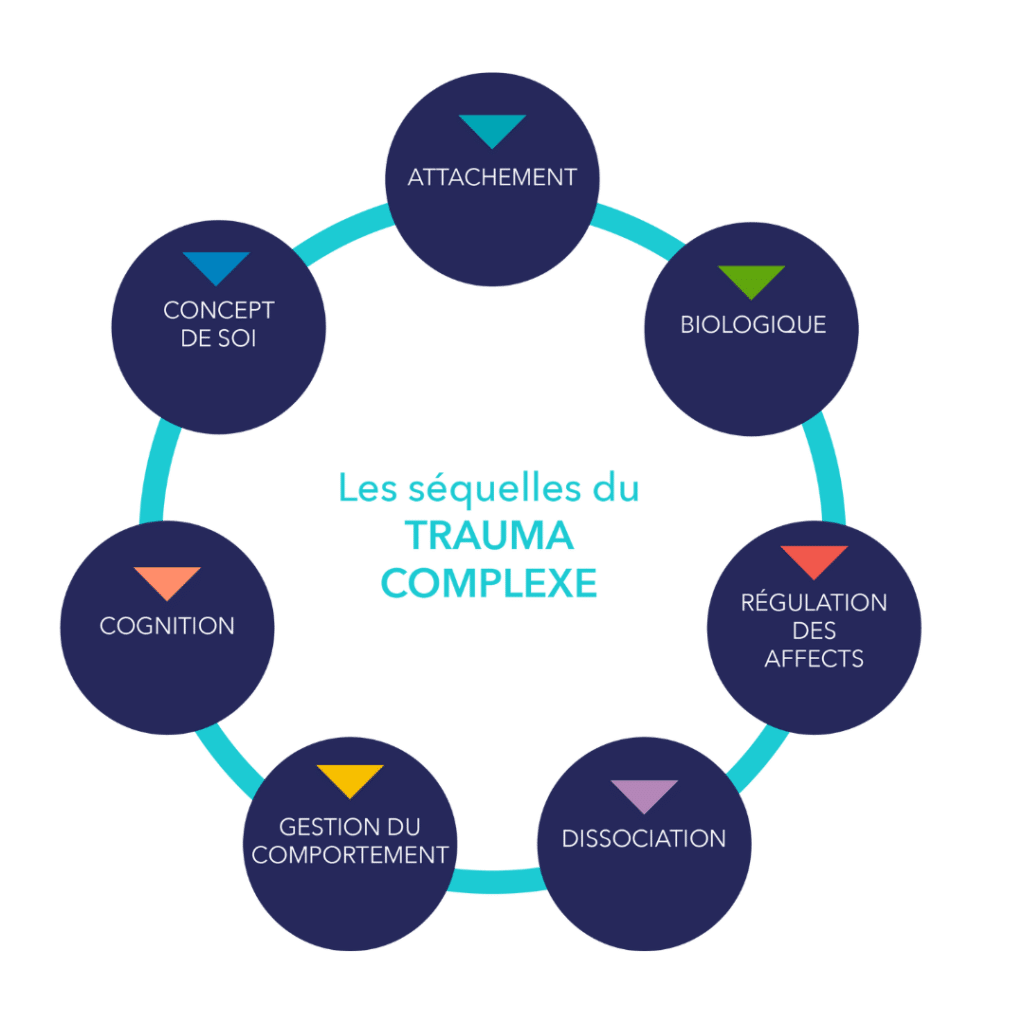
Complex trauma can be defined as a set of developmental after-effects related to repeated experiences of mistreatment or abuse that occurred during development.
Children must adapt to this hostile climate and develop in an environment in which the response to their needs is unpredictable and where threats to their integrity are common.
Since these experiences occur during the development of these children, complex trauma impacts their cognitive, emotional and relational development.
The impact of complex trauma is reflected in a variety of after-effects, including attachment, biology, affect regulation, dissociation, behaviour management, cognition, and self-concept (Cook et al., 2003; Milot et al., 2013).
In short, complex trauma affects the way young individuals function and the way they conceive the world and interact with it.
Why take an interest in complex trauma among young people under youth protection?
Several U.S. studies report a particularly high rate of traumatic exposure among youth housed in rehabilitation centres (Fischer et al., 2016; Pane Seifert et al., 2015) or youth protection (Greeson et al. 2011).
In Québec, young people placed in foster care under the Youth Protection Act (YCJA) are particularly at risk of having experienced various traumatic experiences such as neglect, exposure to domestic violence and physical, sexual or psychological abuse.
A study by Collin-Vézina et al. (2011) showed that more than 3 out of 5 young people had experienced more than two types of traumatic experiences, while 1 out of 5 had experienced five types. Despite this, these young people were nevertheless mostly followed for reasons related to their behavioural disturbances.
These studies highlight the importance of understanding the impact of different forms of mistreatment on children’s lives. They also support the adoption of a trauma-informed approach that prioritizes the creation of safe, sensitive and caring environments that can help them overcome these traumatic experiences (Collin-Vezina and Milne, 2014; Plumb et al., 2016).
What You Get with the Pingouin-Polaris Program
Take the Next Steps
Would you like more information or to find out more about the Pingouin-Polaris program?
The Pingouin-Polaris Program, in Numbers
Generates Positive Impact with 80% of Our Partners
Main finding of the awareness study:
According to the awareness study conducted by Abscisse Research Inc. in 2023, the Pingouin-Polaris program generates significant positive effects with more than 80% of the partners who have implemented it. We plan to continue to evaluate the Pingouin-Polaris program over the next few years.
Reduction of punitive interventions: In Québec, Matte-Landry and Collin-Vézina (2021) evaluated the effects of training on the trauma-informed approach in the child protection sector among staff in 44 living units.
Some of these environments had received the Pingouin-Polaris trauma-informed training orientation, while the majority had received equivalent training from the research team.
The results show that this type of training has significantly reduced the use of punitive interventions such as restraint, seclusion and time-out among young people (Matte-Landry and Collin-Vézina, 2021).
This decrease is more significant among young people who frequently experienced this type of intervention. The study concludes that those who need it the most are the ones who benefit most from the positive outcomes of this type of training (Matte-Landry and Collin-Vézina, 2024).
Reduction of punitive interventions Study of 44 Living Units
The Pingouin-Polaris Program Across Québec

12 Training Partners
8 Regions in Québec Where the Program was Implemented
Useful Links

Get the Latest About Pingouin Polaris!
Challenges and Implementation Strategies
Learn how our team implements trauma-informed practices to support foster youth. In this video, we share concrete strategies and approaches to create a safe and caring environment.
Resisting Institutionalization with Tools Based on the Trauma-Informed Approach
Discover how tools based on the understanding of the trauma experienced by young people can help to better support and accompany vulnerable people, while respecting their dignity and individual needs.
2022 Provincial Community of Practice
Discover the teachings of the Pingouin-Polaris Communities of Practice on Trauma-Informed Practices: a collaborative event by Boscoville.
Researchers and Consultants

Alexandra Matte-Landry
PhD, Assistant Professor, School of Social Work and Criminology, Faculty of Social Sciences, Université Laval

Denise Michelle Brend, Ph. D.
Assistant Professor, School of Social Work and Criminology, Université Laval.

Delphine Collin-Vézina, Ph. D.
Adjunct Professor, School of Social Work, McGill University.
In Partnership With