


The Indigenous Initiatives come to life through collaborative projects with Indigenous communities. These focus on a participatory program design and implementation, involving Indigenous communities, researchers, and Boscoville.
Boscoville recognizes the unique strengths and challenges the Indigenous communities face.
Our approach is based on flexibility and a deep respect for the cultural values of these communities.
This constantly evolving initiative is informed by the principles of “Two-Eyed Seeing” (or Etuaptmumk): a dynamic combination of the expertise and knowledge of Indigenous practitioners, in harmony with our in-house expertise. This collaborative approach takes into account both the traditional wisdom specific to each community and contemporary scientific knowledge.
An in-depth analysis of the needs, notably through interviews with Indigenous community members, mirrors the collaborative development process. Each steps of the projects are designed to ensure the programs meet the needs of the communities and the people they serve.
Cultural Relevance
Every project is different from one community to the next, arising from emerging local needs, strengths and practices. Our approach is to work closely together to create co-developed, culturally safe responses to these needs, whether in a rehabilitation, family support or community care context.
Based On
The “Two-Eyed Seeing” or “Etuaptmumk“, approach, cultural safety, appreciative and participatory approaches.
Our Commitment to Indigenous Communities
Our mandate is to provide culturally safe and relevant training and support to develop psychosocial practices within Indigenous communities.
We support Indigenous self-determination and aim to build learning communities with our Indigenous partners that honour and integrate local strengths and preferences.
Although we offer a breadth of expertise, we acknowledge that system interventions and sustainable growth must be rooted in community knowledge, culture and needs.
Our Projects with Indigenous Communities
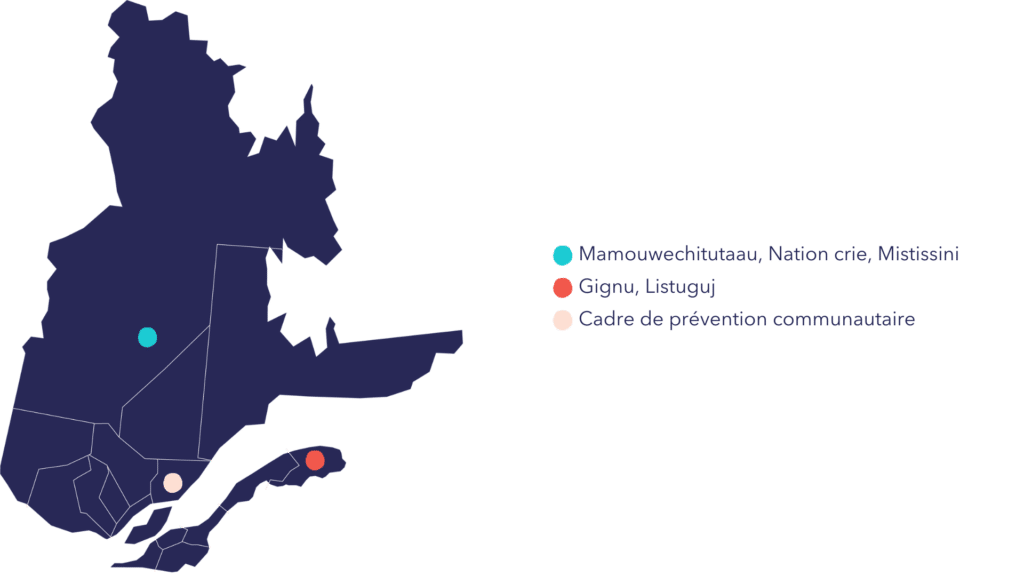
Our 3 Working Principles
There is no “one answer” to organizational change. Every project is different, depending on the particularities of the community we work with. Three fundamental principles underpin our approach to work:

Community Strategies: The strategies chosen by the community are the ones that work best. For a project to be sustainable, it must reflect the community it serves.

Sharing Expertise: Every organization has a wealth of knowledge and experience. Our role is to promote this knowledge and consolidate it.

Relational Learning: We prioritize experiential learning methods that maximize opportunities to laugh, talk, share, bond, and practice skills together on a regular basis. When invited, Boscoville spends time in the community, on the field and in cultural spaces with the aim of immersing ourselves and creating a fruitful, collaborative alliance and relationship.
Objectives of Indigenous Initiatives
We promote experiential methods of knowledge transfer that engage all learning styles. The goal is to develop the confidence and skills necessary to offer locally directed, trauma-informed approaches for youth in prevention and intervention environments.
The aim is also to support the emergence and development of prevention and intervention training and practices, so that they are locally relevant and culturally safe for Indigenous service providers.
No two Indigenous communities are alike. Consequently, each project developed has its own characteristics and objectives.
What You Get with the Indigenous Initiatives
Take The Next Steps
Would you like more information or to find out more about the Indigenous initiatives?

Research Results
An assessment carried out in 2020 by Dr. Elizabeth Fast reported very positive results. In accordance with the Cree Nation’s research sharing policy, this report can only be shared with their permission, to those who specifically request it.
The report can be accessed by contacting: Surveillance, Evaluation, Research and Communications (SERC), Public Health Department, Pimuhteheu.
Useful Links
Find Out More
Researchers and Consultants

Elisabeth Fast, Ph. D.
Adjunct Professor, Department of Applied Human Sciences, Concordia University
In collaboration with