



Based On
The following are the underlying approaches and theoretical models of the GRD program:
- Harm Reduction
- Law of Effect
- Motivational Approach
- Psychoeducative Approach
- Cognitive-Behavioral Approach

The Foundations of the GRD Program
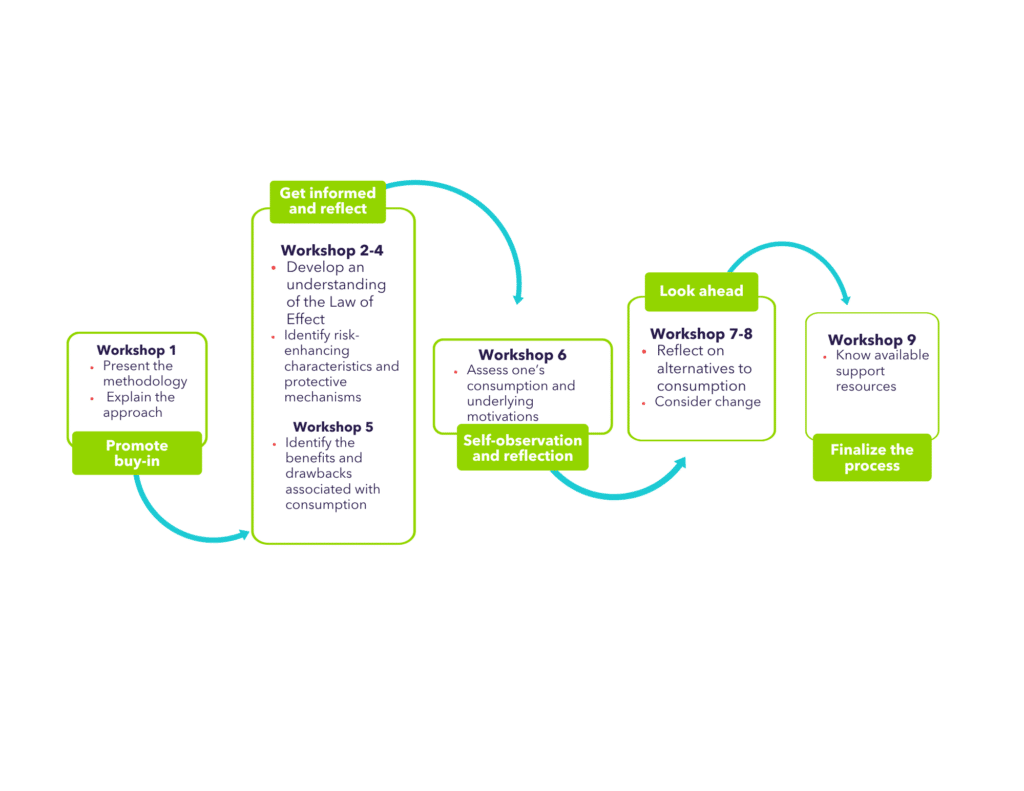
The GRD program is designed to promote introspection and the adoption of various harm reduction strategies associated with psychoactive substance use.
GRD workshops were developed to support a group of young people through their journey towards change, while respecting their pace.
The selection of participants is done through the DEP-ADO questionnaire (Germain et al., 2016) about the assessment of drug and alcohol use problems in adolescents.
Objectives of the GRD Program
The GRD program aims to improve the quality of life and emotional well-being of adolescents. More specifically, the objectives of the program are to:
- Make participants reflect about their substance use habits so they can reduce the associated risks and consequences
- Inspire participants to become more responsible and acquire prosocial behaviours
- Foster the motivation to use substance addiction services among adolescents in need of such services
Substance Use Problems Among Adolescents: Issues and Interventions
Data from the most recent study of the Institut de la statistique du Québec (Traoré et al., 2021) indicates that 10% of high school students use alcohol repeatedly and excessively and that 4.5% use cannabis regularly.
In light of the associated risks, these substance use habits are a cause for concern. Generally, these risks include the possibility of experiencing adverse effects or an incident related to the substance, context or person.
Risks Associated with Substance Use
There are many potential consequences related to drug and alcohol use problems during adolescence at the physical, psychological or financial levels (Brière et al., 2014; Toumbourou and Catalano, 2005).
Moreover, drug and alcohol use are also associated with at-risk behaviours, such as risky sexual behaviours, impaired driving or violent physical and sexual behaviours (Lambert et al., 2012; Tapert et al., 2001).
For youth with more regular or risky substance use, targeted prevention measures can be effective (Bourdillon et al., 2011; Laventure et al., 2010). The GRD program offers an intervention to meet the specific needs of young people for whom a universal intervention would not be sufficient.
What You Get with the GRD Program
Take the Next Steps
Would you like more information or to find out more about the GRD program?
The GRD Program, in Numbers
Reduction of Risks Associated with Drug and Alcohol Use and Improvement of Practices in School Environments
Laventure, M. (2022) Assessment of the Implementation of the GRD Program in School Environments and Development of the Participants Presentation at Boscoville on April 22, 2022.
The results of the assessment in school environments have shown interesting effects (Laventure, 2022):
- Changes in Substance Use: An effect that is usually noted over the medium to long term.
- Decreased Risk Taking: The GRD program aims, in the first place, to decrease the associated risk-taking behaviours, which could explain why an immediate decrease in substance use was not observed (Laventure et al., submitted).
- Positive Adoption: Positive effects on other key variables have been reported, namely more motivation for change and an increase in the adoption of productive strategies.
- Steps Taken with Specialized Services: Following their participation in GRD, 40% of participants have decided to continue their efforts with specialized addiction services (Laventure et al., submitted).
- Learning for Social Care Professionals: Following their participation in GRD training, 96% of social care professionals have mentioned having acquired knowledge that can be used in their daily practice.
The GRD Program Across Québec

120 Trained Social Care Professionals
13 Authorized Environments
Useful Links

Get the Latest About GRD!
DEP-ADO Tool
The DEP-ADO is a concise assessment tool designed to identify alcohol and drug use problems in adolescents.
The questionnaire, initially developed for frontline social care professionals, offers a fast and scientifically valid method to assess substance use behaviours. Available in English and French.
GRD Infographic
This infographic offers a clear overview of the principles and benefits of the GRD Program.

Researchers and Consultants

Myriam Laventure, Ph. D.
Full Professor, Department of Psychoeducation, Université de Sherbrooke.

Jean-Sébastien Fallu, PhD in Psychology
Associate Professor, School of Psychoeducation
Université de Montréal (UdeM)
In Partnership With